|
|
|
| |||||||||||||||||||||||||||
|
Advantages Of Using TF Sealant: UV Resistant Flexibility for future changes Protects the pond base from deterioration Little or no maintenance Eliminates the cost of expensive alternatives No need for special equipment or handling Completely safe for fish |
 germination by holding soil and moisture is place), WALKWAYS.
TF Sealant is an excellent and cost effective substitute for lime and
other traditional base stabilizers.
GENERAL GUIDELINES
Dust Control and Soil
Erosion Control TF Sealant
Dust Control and Soil
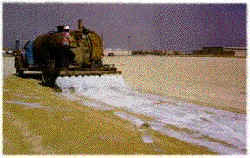
Erosion Control TF Sealant is highly effective against the problems
associated with dust pollution and soil erosion. The product is simply mixed
with water and applied over the surface of the area of coverage with a
minimum of two applications. When properly applied in sufficient quantities,
TF Sealant will quickly dry into a hardened membrane, which will trap
soil particles and loose aggregate, and as a side benefit, it will provide
excellent upper level base stabilization. All that is needed is a water
truck or other means of even distribution of TF Sealant. Simply apply
a mixture of TF Sealant and water directly over the area of coverage
with two or more applications and allow each application to thoroughly soak
into the upper levels of the soil. After compaction, the end result is an
elimination of dust and a highly effective barrier against moisture. When
the mixture of TF Sealant and water has been absorbed completely into
the soil, a curing process will transform TF Sealant from a liquid
into a solid, thereby trapping the dust and solidifying the ground into a
hardened and moisture resistant membrane.
How well does it work? A picture is worth a thousand words!
|
Before TF
Sealant. Both cars 30 miles per hour. |
After TF Sealant
Same speed, same road 1 day later |
|
|
|
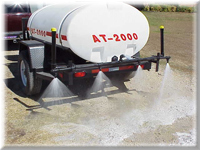
Equipment. The above process is typically
accomplished with a water truck supporting a spray bar mounted 12 to 30
inches above the ground. A "rubber tire" compactor is useful in providing
immediate compaction, but if not available, the area coverage will
eventually be compacted by routine traffic.
TF Sealant TF Sealant is totally environmentally safe, and is certified
as such. A letter is available which states the following.
Ref: Code of Federal Regulations – Protection of Environment, Part 401.15 and Appendix a to Part 403, revised July 1, 1995
This letter certifies that none of the chemicals used in the manufacturing of TF Sealant Liquid Soil Sealant are listed on the attached environmental protection listings for toxic pollutants and priority pollutants.
Liquid Pond Sealant and Stabilizer
TF Sealant Liquid Pond Sealant and Stabilizer is an all-purpose liquid additive for all types of soils used in the construction of earthen ponds. The product is specially formulated to give maximum strength and moisture resistance for base applications. TF Sealant is an excellent alternative to the costly options of excavating and replacing unsuitable soils or installing other types of expensive liner systems. The product is easy to use and it requires no special equipment or handling procedures. It is simply integrated into routine construction procedures by adding it into the water of a water truck and distributing it evenly throughout the area of coverage. After compaction, the end result is a greatly strengthened and superior pond base, which will prevent leakage and costly future repairs.
Erosion Control/Seeding
SAVE TIME AND MONEY USING OUR TF Sealant PROCESS. DON'T WORRY ABOUT YOUR SEED WASHING AWAY. Grow grass through our TF Sealant if the mix is 10 parts water to 1 part TF Sealant. The best stabilization (Erosion Control) process.
The TF Sealant process is easily accommodated into routine procedures with no requirement for special equipment or handling procedures. Broadcast grass seed over a designated area, cover grass seed with a thin layer of composted material or soil, at least 1/4 inch, then apply TF Sealant to top layer of soil. You will be amazed at how your grass will grow and how it will control the erosion. Grass grows very well through TF Sealant diluted 10 to 1. TF Sealant acts like a plastic wrap, coating the area trapping the moisture into the soil. It allows the seeds to germinate faster. Water could still be applied to the surface and water will penetrate into the soil.
This is one product contractors, nurseries, erosion control specialists and others cannot do without!!
Environmentally Safe: One of the most important benefits of using TF Sealant for the construction of earthen ponds is that is environmentally safe. There are no toxic or hazardous chemicals used in the manufacturing of TF Sealant, and when fully cured, it will not re-disperse back into the pond. Fish studies have been conducted with TF Sealant and there are reports available upon request. TF Sealant contains no acids, corrosives, enzymes, chlorides, or lime.As a Barrier Against Moisture: TF Sealant is so effective that, when used in sufficient quantities, it can ultimately be transformed into an impermeable moisture resistant liner. Unlike other liquid additives, when fully cared, TF Sealant will not re-disperse in water or rain, and it is not affected by degradation from alkaline materials and sunlight. Compared to other products, TF Sealant contains no acids, corrosives, enzymes, chlorides, or lime, and the cost savings over geo-textile lines is more than 50 percent.TF Sealant Liquid Soil Sealant and Stabilizer sometimes stymies people with its simplicity. TF Sealant's environmental safety, ease of calculation, and simplicity of application often lead potential users to doubt its efficiency and longevity. "It sounds to good to be true" is often heard. But, it's true! Frequently Asked Questions:Question #1 - What is in TF Sealant that makes it so much better than other soil stabilizers? Answer - TF Sealant is a proprietary blend of copolymers. No element, or combination of elements, before, during, or after manufacture, is included on the USEPA's list of hazardous chemicals. There are no petroleum, or petroleum based, compounds in TF Sealant, alleviating this worldwide concern. Rather than counting on mystic "ion exchanges", or causing physical or chemical changes in the soil, or providing for temporary (biodegradable) stabilization, TF Sealant's copolymer construction binds to itself and the soil as it cures; it binds larger aggregate and suspends the finer materials in a complex, long lasting, matrix of interwoven polymer chains. Question #2 - How much TF Sealant do I need? Answer - As with other forms of stabilization, TF Sealant will work somewhat differently in different types of soil. Generally, the more granular a soil, the more product would be required. A general rule applies that 1/2 gallon of a 1:10 mixture of TF Sealant and water, applied to soil to reach Optimum Moisture Content (OMC), then thoroughly compacted, will achieve superior to excellent base and sub-base stabilization in most soils in the AASHTO spectrum. Due to the need to provide for wear and tear when used on unpaved surfaces, TF Sealant applied to the surface in a 1:5 ratio will allow most surfaces to remain pothole and dust free for a significantly longer period of time than with any other product. Question #3 - How do I apply TF Sealant? Answer - TF Sealant is mixed in a water truck to the proper proportions and applied to the soil surface in two passes. The first pass will use 1/2 of the mixture over the area to be treated. After allowing the product to soak in to the soil for 1-2 hours (depending on local and soil conditions) the truck direction is then reversed (to offset variations in the spray bar) and the remaining 1/2 of the mixture is then applied. This method is used whether one is stabilizing or controlling dust/erosion. The only major difference between the stabilizing or controlling dust/erosion is that when stabilizing, common soil preparation and subsequent compaction methods are used depending on the depth of the soil to be treated. When controlling dust or erosion, TF Sealant is simply applied to the surface of the area requiring treatment and allowed to soak in. NOTE: If this latter area is loose soil, some compaction after application may be necessary. Conversely, if the area to be treated in densely compacted already, the area should be scarified and then lightly compacted prior to applying TF Sealant as a stabilizer or dust/erosion control.Question #4 - Why is TF Sealant more expensive per square yard than other stabilizers? Answer - TF Sealant is more expensive to produce than other stabilizers due to its unique chemical nature. Thus, ounce per ounce, TF Sealant is more expensive than other stabilizers. Also, because TF Sealant is applied to the soil in quantities that produce results superior to the other stabilizers (which are sometimes applied at centiliters per square yard), the net cost of the initial application of TF Sealant will generally be more than with shorter lived stabilizers.Question #5 - Why should I buy TF Sealant when there are less expensive stabilizers?
Answer - Quality, longevity, and lower long-term costs. The savings realized over the years on reapplication, equipment maintenance, and personnel costs, will more than adequately repay the initial costs of TF Sealant.
COMPARISONS BETWEEN TF Sealant AND OTHER TYPES OF STABILIZERS
SULFURIC ACID
More expensive than TF Sealant per area of coverage. Most
expensive shipping rates. Very toxic. Flammable Corrosive – damages
equipment. Environmentally unsafe in the delivered containers. Crystallizes
minerals in the soil. Disposition of empty containers must be accordance
with EPA regulations.
ENZYMES
More expensive than TF Sealant per area of coverage.
Resolubilizes (re-liquefies) more easily in soils with lower percentages of
fines, (i.e. washes out). Recommendation application rate is much lower than
TF Sealant, yet there is no evidence that is a stronger,
even at equal concentration.
CALCIUM CHLORIDE
More expensive than TF Sealant per area of coverage. Surface
applied. Goes on concentrated. Only penetrates 1 to 3 inches below the
surface. Therefore, load bearing capacity is much less than TF
Sealant. Corrosive. Very Slippery when wet.
LIGNOSITE
More expensive than TF Sealant. Derivative of tree sap.
Resolubilizes (re-liquefies) easily. Used mostly for dust control. Not as
well known for serious base stabilization, although advertised as such.
Often advertised as bio-degradable.LIME AND SOIL CEMENTMuch more
expensive than TF Sealant. Very dusty. Harmful to equipment,
vegetation and people. Special equipment and handling required.
There is also a Village builder soil block manufacturing machine that produces 10,000 interlocking blocks in 10 hours using your soil and TF Sealant.

You may have heard the old saying, "Rome wasn’t built in a day." If the ancient Romans had owned a fleet of Village Builders, the feat of building the city in a very short time would have been more imaginable.
 The Village
Builder Soil Block Machine… employs the age old technology of using
native soils to build homes, and other types of structures, and it combines
it with the sophistication and acceleration of modern technology. The result
is one of the most efficient and productive methods of construction on
today’s expanding demand for inexpensive and environmentally safe dwellings.
Quite simply, The Village Builder dramatically increases the speed
and quality with which soil blocks can be made in the areas of the world
where soil block or "adobe" style construction is a viable option. The
Village Builder is the modern day answer for providing a means of
significantly enhancing the centuries old process of making soil blocks by
hand or other methods which are slow, crude and cumbersome.
The Village
Builder Soil Block Machine… employs the age old technology of using
native soils to build homes, and other types of structures, and it combines
it with the sophistication and acceleration of modern technology. The result
is one of the most efficient and productive methods of construction on
today’s expanding demand for inexpensive and environmentally safe dwellings.
Quite simply, The Village Builder dramatically increases the speed
and quality with which soil blocks can be made in the areas of the world
where soil block or "adobe" style construction is a viable option. The
Village Builder is the modern day answer for providing a means of
significantly enhancing the centuries old process of making soil blocks by
hand or other methods which are slow, crude and cumbersome.
The Machine… The Village Builder Soil Block Machine is, by far, the most advanced and reliable soil block machine in the building market. Engineering quality and rugged design have transformed The Village Builder into one of the most dependable and versatile machines of its kind. It can easily be transported to almost any part of the world and can immediately be put into production with little or no field preparation, and with only a few people in the start up crew.
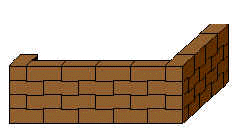
The Block… Blocks are produced by The Village Builder can be used for construction as soon as they are made. They self seal as the TF Sealant cures. If you do not build as you make them you can use more TF Sealant as an adhesive later. A Village Builder SBM (Soil Block Machine), consisting of a power source and one or two chamber units. It can produce blocks at the rate of 16 to 24 – 4 in wide x 4 in high x 8 inch long blocks per minute at a sustained rate of over 1,000 blocks per hour. The cost per block can be as low as 25 cents including the TF Sealant.
Village Builder Advantages…
Self Aligning Blocks Superior Compressive Strength Mortarless Stacking
Compatible with Soil Additives Superior machine mobility Minimum Labor Costs
Cost Effectiveness.
|
Properties
|
|
| Solids | 39% Minimum |
| PH | 8.9 – 9.5 |
| Viscosity | |
| (LVF#3 Spindle @60 rpm) | 1500cps Maximum |
| Gel 30 Mesh, gr./qt. | 0.1 Maximum |
| Gel 100 Mesh, gr./qt. | 5.0 Maximum |
| Gel 325 Mesh, gr./qt. | 10.0 Maximum |
| MFT (Deg C) | 0 – 20 |
| Tg ( Deg C) | -5 - +25 |
| Color | Wet is milky white but dries clear |
How Much Sealant Do You Need
Total Square Yards_____________X.5 =
Total Gal. of Water_______________
Divided by 7 =________________Total Gal. of Sealant Divided by 55 = _______
Total Drums Application / Dilution
Dust Control : Non-traffic areas - 55 gallons of Sealant to 400 gallons of water per surface acreTraffic Areas – 75 gallons of sealant to 260 gallons of water per surface acreStir and apply with conventional spray equipment. Use large droplets and avoid spraying as a fine mist.Coal Piles – To prevent excess water penetration apply 3 coats as follows per surface acre: First Coat – Dilute 55 gallons of Sealant 8:1 with water and apply in large droplets. Second Coat – Dilute 55 gallons of Sealant 4:1 with water and apply in large droplets. Third Coat – Dilute 55 gallons of Sealant 2:1 with water and apply in large droplets. Allow 2-3 hours drying timeErosion Control – Coal Storage, fine powders (coke and metallic ores); 110 gallons of Sealant 4:1 with water per surface acre. Apply half of total in each of two applications with 1-2 hours drying time between coats. Use at least two spray passes to prevent excessive runoff during application.Soil Stabilization – Per surface acre – 100 gallons of Sealant, 1500 gallons of water, 600 pounds of wood fiber, and fertilizer and seed as required. Road Base Stabilization: Ease of Use - There are no special requirements for equipment or handling procedures. This product is simply mixed with water and dispersed into the soil in quantities that are sufficient to control major soil problems such as soil erosion, dust pollution and upper level base failure. When properly applied, TF Sealant will quickly dry into a hardened membrane and, unlike competitive products, it will not re-disperse when exposed to moisture.Soil Conditions – All soil types are suitable for TF Sealant. However, due to fluctuating absorption rates associated with different soils, the amount of required TF Sealant may vary from one application to another.
The FIRST APPLICATION will penetrate from 1-3 inches
into the soil and will serve as a primer for the second application, which
will settle closer to the surface. The first application should be
completely distributed throughout the area of coverage, and allowed to soak
thoroughly into the soil for at least one hour prior to initiation of the
second application. All of the soil must be completely covered with TF
Sealant, even to the extent that an extra pass during the first application
may be required over the area of coverage.
The SECOND APPLICATION, which is the
sealing application, will soak into the soil at a much slower rate and will
bind to the first application. Most of the product will be concentrated near
the surface and will form a hardened membrane, which will trap dust and
aggregate and will resist the invasion of moisture, and if used in
sufficient concentrations, it can ultimately transformed into a flexible
liner.
|
|